Why Generic SEO Tools Fail to Track True Oakland Map Pack Movement
Why Generic SEO Tools Fail to Track True Oakland Map Pack Movement
You are sitting in your office in Downtown Oakland, looking at a ranking report from your expensive, all-in-one SEO dashboard. It says you are in Position 1 for your primary service. You feel a sense of accomplishment – until you look at your call logs. The phone isn’t ringing. Your lead volume is stagnant. You open your phone, stand near the window overlooking Lake Merritt, and search for your own business. To your horror, you aren’t first. You aren’t even in the top three. You are buried in the “More Places” basement.
Welcome to the “Ghost Ranking” phenomenon. It is the most common frustration for Oakland business owners in 2026, and it is caused by a fundamental technical failure in how generic SEO tools track local visibility. If you are relying on standard software to manage your google business profile seo, you aren’t just getting incomplete data – you are getting lies.
In this deep dive, we are going to dismantle the “Proximity Trap,” explain why your current tracking software is failing you, and show you the technical reality of how to actually rank google business profile assets in a city as geographically and demographically diverse as Oakland.
1. The “Ghost Ranking” Phenomenon in Oakland
The discrepancy between what your SEO tool says and what a real user sees is not a glitch; it’s a limitation of legacy technology. Generic SEO tools were built to track organic blue links – the “Global SERPs.” These tools typically track rankings by “spoofing” a location, usually defaulting to a city’s central zip code or a data center IP address. For Oakland, this often means your tool is checking your rank as if the searcher is standing exactly at City Hall.
But local search doesn’t work that way anymore. In 2026, google business profile seo signals account for a staggering 30-35% of local ranking factors. These signals are hyper-sensitive to the user’s physical coordinates. If your tracker is checking from a server in San Jose or even a fixed point in Frank Ogawa Plaza, it is missing the reality of a customer searching from a cafe in Temescal or a home in Jack London Square.
A “Ghost Ranking” occurs when your software reports a “win” based on a single, static data point, while you are invisible to 90% of the actual city. This is why many businesses find that Why Your Oakland Shop Stays Invisible Despite a Perfect Business Profile – they are optimizing for a ghost, not a local customer.
2. The Technical Failure of Generic Trackers
To understand why your current local seo tools are failing, we have to look at the difference between IP-based location spoofing and true geocoded tracking. Most “all-in-one” platforms use a method called “Centroid Tracking.” They send a query to Google and tell the search engine, “I am in Oakland, CA.” Google then provides results based on the geographic center of the city.
The problem? Oakland isn’t a single point. It’s a sprawling landscape of hills, industrial zones, and distinct neighborhoods. Google’s RankBrain and its sophisticated AI layers don’t just look at the word “Oakland.” They look at the user’s precise latitude and longitude, their past search history, and the “Personalization” of the results.
Generic trackers ignore the following technical realities:
- GPS Precision: Google Maps uses mobile GPS data, which is accurate within meters. Most SEO tools use IP data, which is lucky to be accurate within miles.
- The “Near Me” Intent: When a user in Rockridge searches for a “plumber,” Google knows they aren’t looking for someone in San Leandro, even if both businesses have “Oakland” in their address.
- Hyper-Local Competition: The competitive landscape changes every few hundred yards. A law firm might dominate the Map Pack near the Alameda County Superior Court but disappear entirely by the time the user reaches Piedmont.
Without specialized google maps ranking service capabilities, you are essentially trying to navigate the Oakland hills with a map of the entire United States. It’s too zoomed out to be useful.
3. The Proximity Trap: Why 2 Blocks Changes Everything
The “Proximity Trap” is a term we use at Oakland SEO Services to describe the shrinking radius of the Local Map Pack. Proximity currently accounts for roughly 20-25% of the total ranking algorithm. In a dense urban environment like Oakland, this factor is amplified.
Imagine a boutique fitness studio located in the Grand Lake district. If a potential client is walking around Lake Merritt, the studio likely appears in the top 3 of the Map Pack. However, if that same client drives just two miles away to the Fruitvale district, the studio might drop to position #12. Why? Because Google has identified closer competitors in Fruitvale and prioritizes the user’s convenience over your business’s “authority.”
This is the Proximity Paradox: as you get better at SEO, your “authority” grows, but your “reach” is still physically tethered to your location. Generic tools fail to show you this boundary. They won’t tell you that you are losing 80% of your potential market because you haven’t optimized for the neighborhoods just outside your immediate two-block radius. This is a primary reason How the Proximity Trap Hides Your Oakland Shop From High-Value Neighborhoods. To break out of this trap and rank higher on google maps, you need data that shows exactly where your visibility ends.
4. Discovery vs. Navigation: The Local Pack Ecosystem
One of the biggest mistakes Oakland marketers make is treating the Google Map Pack (the three results shown on a standard Google search) and the Google Maps App as the same thing. They aren’t. They serve different intents, and they use different ranking weights.
Research into the “Local Dominator” effect shows a clear split:
- The Local Pack (Discovery): This is for users who are in the “research” phase. Google prioritizes Prominence – your reputation, your review count, and your google business profile optimization. They want to show the “best” options in Oakland.
- The Google Maps App (Navigation): This is for users in the “action” phase. Here, Google prioritizes Proximity. If a user is driving down Broadway and searches for “coffee,” Google is going to show the shop 100 feet away, even if it has a lower rating than a shop a mile away.
Generic tools usually only track the “Discovery” side of the equation. They don’t account for the “Action” intent that drives the majority of mobile conversions. To truly dominate, you must optimize for 5 Signals That Actually Force Google to Show Your Oakland Shop in the Map Pack, ensuring you are visible during both the discovery and navigation phases of the customer journey.
5. Why You Need Grid-Based Tracking in 2026
If you want to improve google maps rankings, you have to stop looking at a single number. A “Rank 3” average is a meaningless metric. What you need is a google maps rank tracker that utilizes a geocoded grid.
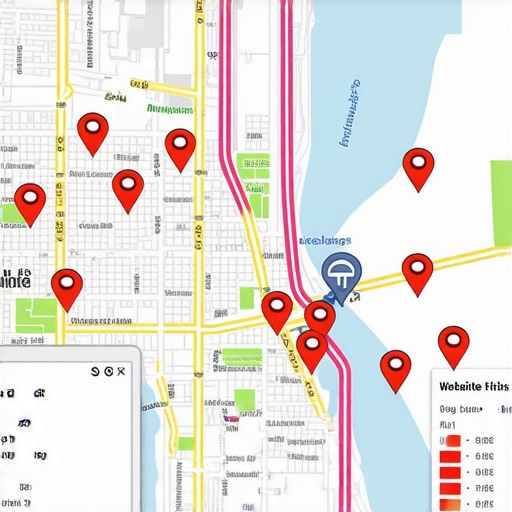
A grid-based tracker (like the ones found in high-end google maps seo tools) places a 13×13 or 15×15 grid of virtual “searchers” over a map of Oakland. Each point on the grid performs a search and records your position. The result is a “Heat Map” of your visibility.
With a grid, you can see exactly where your “green zone” (Positions 1-3) ends and your “red zone” (Position 4+) begins. This allows for surgical SEO strikes. For example:
- If you see you are ranking well in Montclair but failing in Piedmont, you can create localized content or run geo-fenced ads specifically for that gap.
- If your heat map shows a sudden “hole” in visibility in West Oakland, you can investigate if a competitor has recently updated their profile or if there is a data inconsistency in your citations.
This level of granularity is the only way to combat the reporting errors that plague standard audits. Often, Why Your Oakland Local SEO Reporting Is Giving You the Wrong Data comes down to the simple fact that your software is averaging your “Position 1” in your lobby with your “Position 20” three blocks away, giving you a misleading “Position 10” that helps no one.
6. Beyond Tracking: Optimizing for “Openness” and Behavioral Signals
In 2026, tracking is only half the battle. Google has introduced new filters that can make your business vanish instantly, regardless of your SEO strength. The most notable is the “Openness” filter.
Google has become much more aggressive about hiding businesses that are currently closed. If a user searches for a “med spa in Oakland” at 7:00 PM, and your profile says you closed at 6:00 PM, you will likely be filtered out of the top results entirely, even if you are the most authoritative business in the city. This is a critical nuance that generic tools fail to capture. They might track your rank at 10:00 AM when you are open, but they won’t tell you that Why Your Oakland Business Map Pin Keeps Disappearing After Business Hours is costing you evening leads from people planning for the next day.
Furthermore, behavioral signals – like Click-Through Rate (CTR) from the Map Pack to your website, direction requests, and “click-to-call” actions – are rising in importance. Google’s RankBrain analyzes these interactions to determine if users are satisfied with the results. If your profile is “ranking” but no one is clicking, Google will quickly demote you. Specialized gmb seo tools track these interactions in real-time, giving you the data needed to adjust your photos, posts, and Q&A sections to drive more engagement.
7. Conclusion: Reclaiming Your Oakland Visibility
The “all-in-one” SEO era is over for local businesses. If you are serious about growing your Oakland company, you cannot rely on tools that treat our city like a single, static point on a map. You are competing in a hyper-local, real-time environment where proximity, openness, and behavioral signals dictate who gets the phone call and who stays invisible.
To reclaim your visibility, you must move beyond generic trackers. You need a comprehensive google business profile optimization strategy backed by grid-based data. Whether you choose to invest in specialized google business profile audit tool software or partner with an Oakland Google Business Profile Consultant, the goal is the same: stop chasing “Ghost Rankings” and start appearing where your customers actually are.
Don’t let the Proximity Trap stifle your growth. Audit your current tracking today and see the “Heat Map” of your true Oakland presence. The data might surprise you, but it is the only path to real-world ROI.