
The Honest Reason Most Oakland Local SEO Audits Miss the Real Problem
The Honest Reason Most Oakland Local SEO Audits Miss the Real Problem
If you are an Oakland business owner, you have likely been bombarded with “free SEO audits” from agencies promising to fix your rankings. You open the PDF, and it’s a generic checklist telling you that your NAP (Name, Address, Phone number) is inconsistent on three obscure directories or that your meta descriptions are five characters too long. It’s fluff. It’s 2026, and if your “expert” is still treating a local seo audit like a 2015 checklist, they are the reason your phone isn’t ringing.
The reality of the Oakland market is far more complex than a simple checklist. Between the shifting economic landscape and Google’s aggressive transition toward “Entity Authority,” the old rules of local search have been shredded. Most audits miss the real problem because they look at your business in a vacuum. They don’t account for the “Proximity Trap,” the technical ghosting of your map pin, or the hyper-local relevance required to compete in a city where foot traffic patterns are radically changing. I’ve seen countless med spas in Rockridge and law firms in Downtown Oakland wondering why they are invisible to customers just three blocks away. The answer isn’t in your NAP consistency; it’s in your technical signals and local authority.
The “Surface-Level” Audit Trap: Why Generic Checklists Fail
The standard 18-point checklist found on most marketing blogs is a relic. These local seo tools are designed to find “errors” that are easy to fix but have a negligible impact on your actual Map Pack ranking. Why? Because Google has become incredibly good at “normalizing” data. It knows your business is the same entity even if one directory says “St.” and another says “Street.”
The real failure of these generic audits is their inability to understand Oakland’s unique geography. Ranking in the Oakland Hills is a different technical challenge than ranking in Eastmont or Fruitvale. A generic audit won’t tell you why your competitor in Temescal is outranking you for searches happening in Piedmont. This is often due to a lack of geo-relevance – a metric most automated tools can’t quantify. If you want to know if you’re being misled, you need to learn how to spot a fake Oakland SEO audit that’s wasting your time. These “fake” audits ignore the nuances of the local market and focus on vanity metrics that don’t drive revenue.
Furthermore, many business owners are led astray by software that provides a static “score.” As I’ve discussed before, why local search software often misleads Oakland small business owners is simple: it doesn’t account for the real-time volatility of the Map Pack. Google’s local algorithm is now heavily influenced by behavioral signals and “Entity” connections, things a basic crawler simply cannot see.
The Proximity Trap: Why You’re Invisible Two Blocks Away
One of the most frustrating phenomena for Oakland businesses is what I call the “Parking Lot Effect.” You pull out your phone at your office on Broadway, search for your service, and you’re #1. You drive to a coffee shop in Grand Lake, search again, and you’re nowhere to be found. This is the “Proximity Trap,” and most audits completely ignore it.
Google uses a proximity filter to prevent one business from dominating an entire city. However, for many Oakland businesses, this filter is tuned too tightly. If your technical signals are weak, Google “ghosts” your pin the moment a user moves outside your immediate vicinity. This is the brutal reason your Oakland map pin only ranks within your parking lot. To break out of this radius, you need more than just a verified profile; you need a google maps ranking service strategy that builds “geo-fenced authority.”
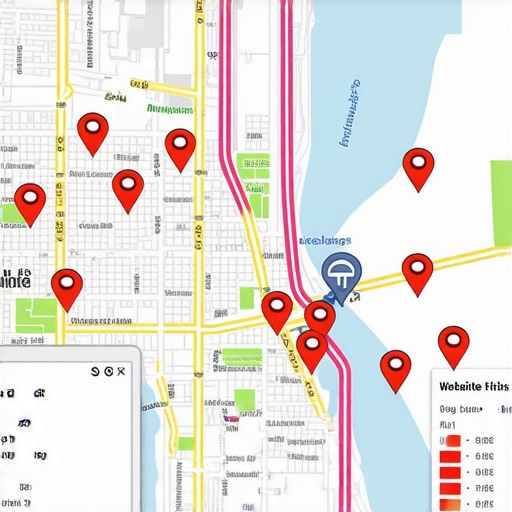
Expanding your ranking radius requires convincing Google that your business is the most relevant result for the entire Oakland area, not just the block you’re on. This involves leveraging hyper-local content and high-quality local citations that signal your involvement in the broader community. If your audit doesn’t include a “Proximity Analysis” or a “Heat Map” of your current rankings, it isn’t giving you the full picture. You are essentially flying blind, unaware that you are invisible to 90% of your potential Oakland customers.
Oakland’s 2026 Economic Reality and Your Map Ranking
To understand why your SEO might be failing, you have to look at the macro environment. According to the Colliers Q4 2024 Office Market Research Report, Oakland is facing historically high office vacancy rates. Simultaneously, the Oakland Chamber of Commerce 2025 Economic Indicators Report highlights a contraction in the daytime population in the downtown core. Why does this matter for your local seo audit?
Google’s algorithm is a reflection of the real world. When foot traffic patterns shift and office buildings sit empty, the “relevance” signals for local businesses must be stronger to compensate for the lack of organic behavioral data. In 2026, Google is looking for active engagement. If your business is located in a high-vacancy zone, you have to work twice as hard to prove you are still a thriving, relevant entity. This is why why your Oakland map pin is vanishing in 2026 is often tied to these broader economic shifts.
Your audit must account for this. Are you generating enough “digital foot traffic” (clicks, calls, direction requests) to offset the decline in physical foot traffic in your neighborhood? If your audit is just looking at your website’s H1 tags, it’s ignoring the very economic reality that is suppressing your visibility. You need to implement California local SEO strategies that specifically target the active demographics remaining in the city.
The “Missing” Technical Signals: Schema, Metadata, and AI Overviews
Modern google business profile seo is no longer just about filling out your “Services” section. It’s about building a machine-readable “Entity.” This is where most Oakland audits fall off a cliff. They focus on what humans see, but they ignore what the AI sees.
The Power of Advanced Schema
Most audits will check if you have basic “LocalBusiness” schema. That’s the bare minimum. A high-level audit looks for “SameAs” attributes that link your profile to other authoritative entities, and “AreaServed” properties that define your Oakland service boundaries. There is often the invisible schema tweak that actually moves your Oakland map pin by clarifying your relationship to specific neighborhoods like Montclair or Adams Point. Without this, Google may struggle to categorize your business accurately within the local hierarchy.
AI Overviews (AEO) and Zero-Click Searches
In 2026, the rise of AI Overviews (formerly SGE) has changed the goalposts. Google is now answering queries directly in the search results, often pulling data from your reviews, your website’s Q&A, and even third-party mentions. If your audit doesn’t analyze how your business appears in AI-generated summaries, you’re missing the future of search. You need to ensure your google business profile seo is optimized for “conversational” queries. This means your content needs to answer the specific, long-tail questions Oaklanders are asking, such as “Who is the best emergency plumber near Lake Merritt?”
Visual Relevance and Metadata
While the old trick of stuffing EXIF data into images is largely dead, “Visual Relevance” is very much alive. Google uses Cloud Vision AI to “read” the photos you upload to your profile. If you’re a contractor in Oakland, but all your photos are stock images or shots of your truck in a generic driveway, you aren’t sending geo-signals. Your photos should feature recognizable Oakland landmarks or streetscapes. This creates a “Visual Entity” that reinforces your location. If your audit doesn’t critique your visual content strategy, it’s incomplete.
Beyond NAP: The 3 Pillars of a Real Oakland SEO Audit
To truly understand why your business is stuck on page two, you need an audit that evaluates the three pillars of modern local search. This is the framework I use to identify 3 Oakland SEO audit mistakes crushing your 2026 traffic.
- 1. Geo-Relevance: This goes beyond your address. It’s about how well your digital footprint is anchored in Oakland. Do you have links from the Oaklandside or East Bay Express? Do you mention local landmarks like the Fox Theater or Jack London Square in your content? Google uses these associations to verify your local “importance.”
- 2. Behavioral Signals: This is the “secret sauce” of the Map Pack. Google tracks how many people click “Call,” how many ask for directions from specific zip codes (like 94611 or 94607), and how many people spend time reading your reviews. If your audit doesn’t look at these interaction rates, it can’t tell you why a competitor with fewer reviews is outranking you.
- 3. Niche Authority: Are you an authority in your specific industry within Oakland? This involves getting citations from niche-specific directories and local associations. Using specialized google maps seo tools can help you identify where your competitors are getting their “authority juice” and how you can replicate it.
If you find that your current strategy is lacking in these areas, you are likely suffering from one of the 5 red flags killing your rank in an Oakland SEO audit 2026. These red flags are often “silent killers” – technical issues or lack of engagement that don’t show up on a standard SEO report but are devastating to your visibility.
The Role of Content in Local Map Rankings
Many business owners think their website and their Google Map pin are two separate things. They aren’t. In fact, the content on your website is one of the strongest drivers of your map ranking. When someone searches for a service in Oakland, Google crawls local websites to find “justification” for ranking a specific map pin. You’ve seen this before: a map result that says “Their website mentions [Service].”
A real audit will analyze your “Local Landing Pages.” Are you just repeating the word “Oakland” fifty times, or are you providing actual value to Oakland residents? You need to demonstrate maps optimization Oakland by creating content that reflects the local culture and needs. This might include a guide to the best parking near your office or a list of local Oakland charities you support. This builds the “Entity Authority” that Google craves.
Furthermore, you should be using rank google business profile techniques to ensure your “Updates” and “Posts” on your profile are keyword-rich and geo-targeted. If you aren’t posting regularly to your profile, you are signaling to Google that your business might be one of the many that has shuttered during the recent economic downturn.
Conclusion: Stop Guessing and Start Ranking
The Oakland market is too competitive and too volatile to rely on generic SEO advice. If your local seo audit doesn’t dive into the technical “Entity” signals, the proximity filter, and the shifting economic realities of our city, it is essentially a waste of paper. You need to move beyond the basics of NAP and start building a hyper-local authority that Google can’t ignore.
Stop letting “surface-level” audits hide the real problems. Whether it’s a technical schema error or a lack of behavioral engagement, you need to know exactly why your shop is hidden from the people who are looking for you. I recommend starting with the 3-minute audit that reveals why your Oakland shop is hidden. It’s time to stop guessing and start implementing a strategy that actually moves the needle in 2026. If you want to dominate the Oakland Map Pack, you have to play the game at a higher level than your competition.