Why Standard Keyword Tracking Usually Lies to Oakland Business Owners
Why Standard Keyword Tracking Usually Lies to Oakland Business Owners
If you own a business in Oakland, you’ve likely received a monthly report from an SEO agency that looks like a victory lap. It’s a clean PDF with green arrows pointing up, proudly claiming you are “#1” for your most important keywords. But as you look at your shop in the Dimond District or your office in Jack London Square, you notice something unsettling: the phone isn’t ringing any more than it was last month. The digital reports show a win, but the physical cash register shows a stalemate.
This is the “Number One” Delusion. In the world of google business profile seo, a single ranking number is not just an oversimplification – it is often a flat-out lie. The reality of local search in 2026 is that “Oakland” is not a single point on a map. It is a complex, hyper-competitive grid of neighborhoods, each with its own digital ecosystem. If your SEO provider is telling you that you rank #1 in Oakland, the first question you should ask is: “Where in Oakland?”
Consider an Oakland plumber. Their agency sends a report saying they rank #1 for “water heater repair.” While that might be true if the search is performed from the agency’s office in Downtown Oakland, that same plumber might be invisible to a homeowner in Rockridge, or buried on page three for a searcher in East Oakland. Traditional SEO reporting ignores the “user behavior math” that governs modern local search. To succeed today, you must move past flat reports and understand how proximity, trust, and real-time user signals dictate who actually gets the call.
Why Standard Keyword Tracking Fails in a Local Economy
The fundamental flaw in traditional rank tracking is that it relies on Point-of-Interest (POI) data. A standard tracker pings Google from a fixed IP address or a single GPS coordinate – usually the center of the city or the business’s physical address. This creates a “false positive” environment. If you are standing in your own lobby, of course, you rank #1. Google knows you are the closest relevant result.
However, Google’s algorithm for the local map pack is built on three pillars: Proximity, Relevance, and Prominence. Standard trackers only measure relevance (keywords) and prominence (backlinks) from a static distance. They fail to account for the “proximity decay” that happens as a searcher moves away from your front door. In a dense urban environment like the Bay Area, proximity is often the heaviest weighted factor. To see how you truly appear to customers, you need a google maps rank tracker that scans from multiple points across the city, not just one.
In 2026, Google’s AI-driven search results are more fluid than ever. They don’t just look at who has the most keywords; they look at “real-world relevance signals.” This means Google is looking for proof that your business is the most logical choice for a specific user at a specific moment. If your tracking software isn’t mimicking the movement of a real human being driving down Broadway or Grand Ave, it isn’t giving you the truth. Professional local seo tools are now required to visualize the “Share of Local Voice” across different neighborhood boundaries.
The Proximity Paradox: Understanding the “Two-Block” Rule
One of the most frustrating experiences for a business owner is realizing that their Oakland map profile isn’t generating phone calls despite “good” rankings. This is often due to the Proximity Paradox. In a city like Oakland, Google applies what we call the “Two-Block Rule.”
Because there is so much business density in areas like Piedmont or Temescal, Google doesn’t need to show a searcher a result from three miles away. If there are five highly-rated, relevant businesses within a six-block radius, Google will prioritize those to provide the most “convenient” experience for the user. This is why your Oakland map ranking fails just two blocks away from your store. You might dominate your immediate street, but as soon as the searcher crosses a major intersection or enters a different zip code, you vanish from the Map Pack.
Google’s goal is “radius made believable.” They won’t show an Oakland shop to a searcher in Berkeley if there are 10 competent options in Berkeley. To combat this, businesses must stop trying to “rank for Oakland” and start trying to expand their “radius of influence.” This involves more than just keywords; it requires building local signals that prove to Google you are worth the “drive time” for a user who isn’t standing right next to you.
Google Ranks Behavior, Not Just Listings
A common misconception in google business profile seo is that a listing is a static entity. In reality, your Google Business Profile (GBP) is a living organism that feeds on user behavior. Google isn’t just ranking businesses; it is ranking the *probability of a successful interaction*.
This is where Click-Through Rate (CTR) and user behavior math come into play. If your business appears in the Map Pack for “best coffee Oakland,” but users consistently scroll past you to click on the competitor below you, Google’s algorithm takes note. Your ranking will drop because the “behavioral math” suggests you aren’t the best answer for that query. This is why google business profile optimization is about more than just filling out your hours and services; it’s about creating a listing that forces a click.
The “Tree Service” Case Study
We recently analyzed an Oakland-based tree service company. They had over 70 five-star reviews, a beautiful website, and a decade of history. On paper, they should have dominated the entire East Bay. However, their google business ranking was non-existent outside of a tiny 1-mile radius around their yard. Why? Because their listing was “boring.” They used stock photos of trees rather than real shots of their branded trucks in Oakland neighborhoods. They didn’t post updates. Their “Share of Local Voice” (SoLV) was low because users weren’t engaging with the listing. Once we optimized for behavioral signals – using “photos that make people click” and neighborhood-specific updates – their radius expanded by 400%.
To rank google business profile listings effectively, you must focus on:
- Primary Category Precision: Ensuring your main category matches the specific intent of Oakland searchers.
- Visual Trust: Using high-resolution, local images that prove you are active in the community.
- Engagement Velocity: How quickly and often users interact with your “Updates” and “Q&A” sections.
The Oakland Competitive Landscape: From Temescal to Montclair
Oakland is a city of distinct micro-markets. A “Med Spa in Temescal” is playing a completely different game than one in “Montclair.” In Temescal, the competition is high-density, foot-traffic heavy, and driven by younger demographics who rely heavily on mobile Map Pack searches. In Montclair, the search intent might be more appointment-based and driven by desktop searches or longer-tail queries.
Effective California Local SEO requires neighborhood-level signals. You cannot expect to rank across the whole city with a generic “Oakland” strategy. You need to feed Google signals that force Google to show your Oakland shop in specific zones. This includes:
- Neighborhood Citations: Getting mentioned on local Oakland blogs, neighborhood association sites, or hyper-local directories.
- Geographic Content: Writing about specific Oakland landmarks or projects you’ve completed in neighborhoods like West Oakland or Fruitvale.
- Localized Backlinks: Links from other Oakland-based businesses and organizations that anchor your relevance to the city.
By treating Oakland as a collection of villages rather than one big city, you can systematically “conquer” the grid, one neighborhood at a time, rather than spreading your SEO budget too thin across the entire map.
How to Get the Truth: Geogrid Heatmaps
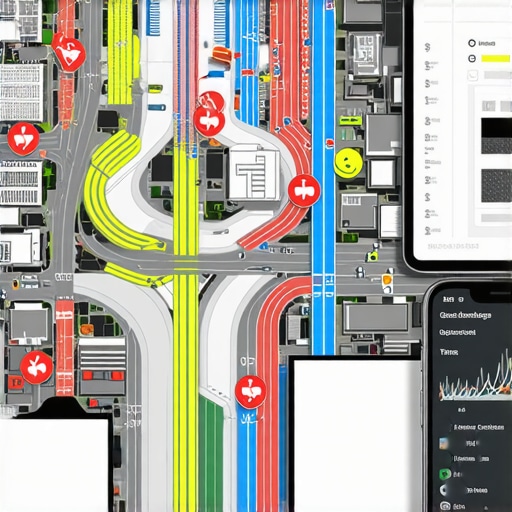
If standard tracking is the problem, Geogrid technology is the solution. Instead of a single ranking number, a Geogrid provides a visual “map of pins” overlaid on Oakland. Each pin represents a specific GPS coordinate, and the number on the pin shows your rank at that exact spot.
This is the only way to perform a real google maps ranking service audit. When you look at a Geogrid, you might see a “1” over your office, but “12s” and “15s” just three blocks away. This visualization instantly identifies where your “proximity wall” is. Once you see the wall, you can work to break through it. Using GBP ranking tools to generate these heatmaps allows you to stop guessing and start marketing with surgical precision.
Modern Maps Optimization Oakland involves identifying these “weak zones” on the grid and deploying localized content and reviews from customers in those specific areas to “turn the pins green.”
Conclusion: The 2026 Local SEO Roadmap
The days of settling for “flat” SEO reports are over. If your current agency is only showing you a single number for your keywords, they are hiding the true state of your business visibility. In 2026, Oakland business owners must demand proximity-based data. You need to know exactly where you are winning and, more importantly, where you are losing.
Stop chasing the “Number One” delusion. Focus on the three pillars of local search: Proximity, Relevance, and Prominence. Optimize for user behavior, embrace neighborhood-specific signals, and use Geogrid technology to see the truth. If you’re ready to see how your business actually looks to your customers, it’s time for a real audit. Visit SEO Viper Tools to run your own heatmap or contact Oakland SEO Services to build a roadmap that actually drives phone calls, not just green arrows on a PDF.